

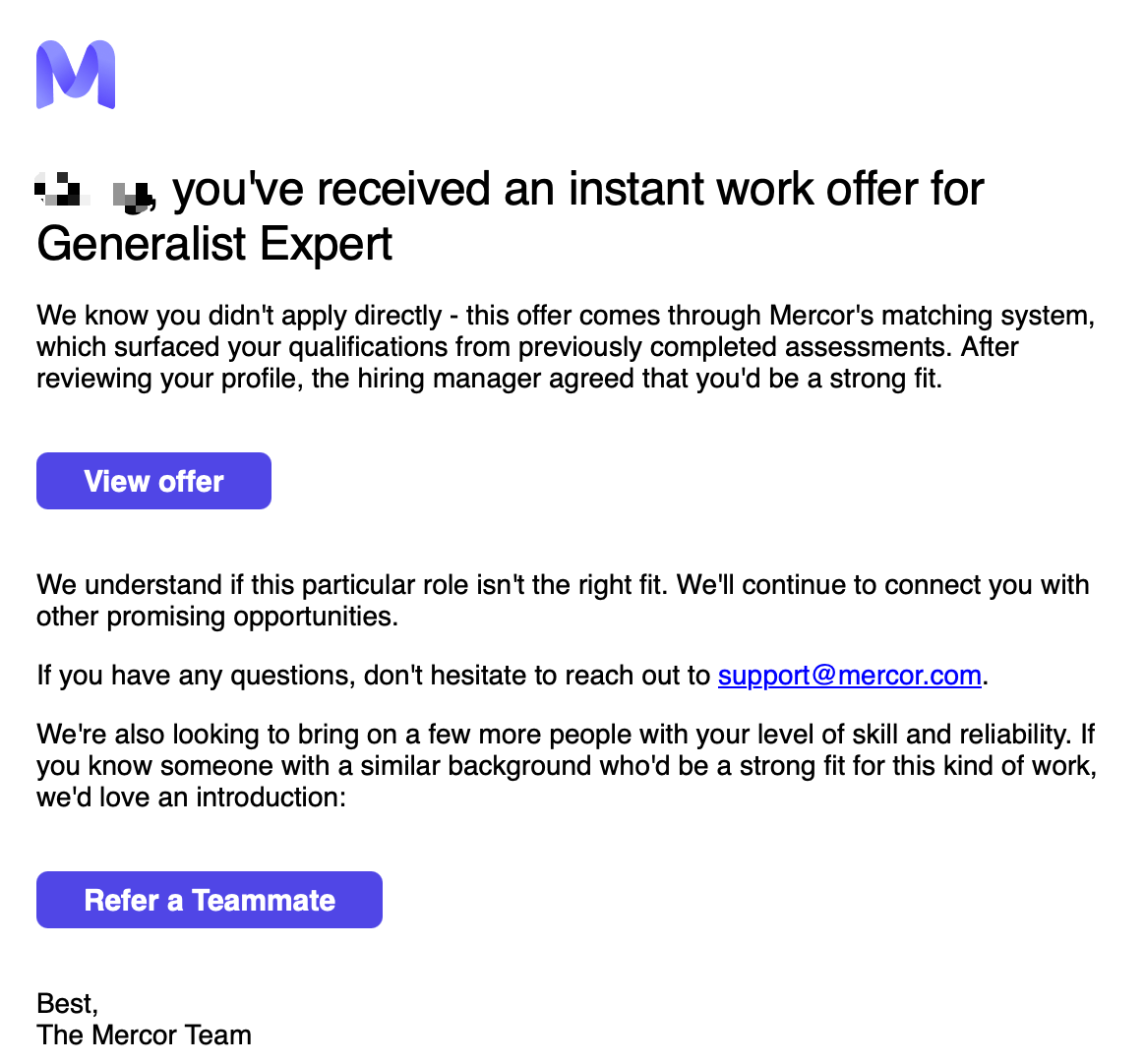
Last week I logged into Mercor, made some edits to my profile, hit save, and within minutes got an offer in my inbox. No interview. No waiting list. No “we’ll get back to you.” Just an offer, ready for me to accept.
I want to walk you through exactly what happened, why it happened, and how you can engineer the same result for yourself. Because once you understand the system on the other side of the screen, getting matched to the right project stops feeling like a lottery and starts feeling like a craft.
This issue is free. The full prompt library, the resume template I now use, and the live “what’s working this month” updates live on the paid side. If you’ve been on the fence about upgrading, this is the issue I’d point you to first — because if even one of the sections below saves you a single rejection, you’ll have made back the subscription many times over.
Let’s get into it.
The offer that landed in my inbox before I even closed the tab
I’ll start with the moment itself, because it still feels strange to me.
I had spent maybe an hour the night before rewriting parts of my profile. Nothing dramatic — I didn’t add new experience, I didn’t take a new course, I didn’t sit a new assessment. I just changed the way my existing work was described. I rephrased my role, restructured my projects section, swapped out a few generic skill keywords for more specific technical ones, and re-uploaded a cleaner version of my resume.
The next morning I logged in to double-check that everything had saved. Before I had even finished scrolling, an offer notification appeared. An hourly project, in my domain, at a rate I was happy with, with the “instant offer” badge on it. Meaning: no live interview, no scheduling, no waiting for a recruiter to review me. Mercor’s matching system had already decided I was a fit, and the client had already pre-approved profiles that scored above a certain threshold.

I want to say it was luck. But I had been on the platform for weeks before this with a profile that, on paper, described exactly the same person. The version of me that got the instant offer was not a more qualified version. It was a better-described version.
That distinction matters more than almost anything else I’m going to tell you in this newsletter, so I want to put it in bold and let it sit on the page for a second:
Mercor is not evaluating you. Mercor is evaluating the document that represents you. And that document is being read by an AI, not a recruiter.
Once I internalized that, everything about how I approached the platform changed. The work I did didn’t become more impressive. The story I told about it did.
In the rest of this newsletter, I want to break down what’s actually happening behind the scenes, what specifically I changed in my resume and profile, the prompt sequence I now use to do this for every new role I target, and where I’m taking this next — including a Claude Code skill I’m starting to prototype that would automate the whole loop.
The thing nobody tells you: Mercor uses AI on both sides of the table
When most people think about Mercor, they think about the assessments. The recorded interviews. The little technical challenges. That’s the part of the experience that feels like the evaluation, so naturally that’s where people focus their effort.

But here’s the part that took me a long time to understand: those assessments are the second step. The first step — the one that decides whether you ever even see a role — is a matching layer. And that matching layer is doing two things, both of them with AI.
The first thing it does is parse every job description into a structured representation: required skills, preferred skills, domain, seniority, language requirements, project shape, rate band. The second thing it does is parse every candidate profile into the same kind of representation, then runs a similarity match. If you and the role score above a threshold, you’re surfaced. If you score above an even higher threshold, you get an instant offer with no human gate in between.
This has two very practical implications.
The first is that the parsing of your resume matters as much as the content. If the AI can’t extract a clean “Skills: Python, SQL, causal inference, Bayesian methods” line from your PDF, then it doesn’t matter that all of those words are technically somewhere in your bullet points. The system never gets to see them. PDFs with images of text, weird two-column layouts, custom fonts that don’t embed properly, headers that confuse the parser — all of these silently destroy your match score without you ever knowing.
The second implication is that you are, in effect, optimizing for a search engine. You don’t need to game it dishonestly — the assessments and the actual work will quickly filter out anyone who oversold themselves. But you do need to make sure that the keywords, framings, and structural cues that the AI is looking for are present, prominent, and parseable. Most people are losing matches not because they aren’t qualified, but because their resume is written for a 2015 human recruiter and not a 2026 LLM.
I think this is the single biggest gap between people who get instant offers on Mercor and people who don’t. It’s not talent. It’s not luck. It’s that one group has figured out they’re writing for a machine reader and the other group hasn’t.
Once you accept that, the entire game becomes: how do I make my profile maximally legible to an AI that is trying to decide if I belong in a specific project? And the answer to that question, it turns out, is something you can solve with another AI.
What I actually changed (and why each change works)
Here is the concrete edit list. I’m not going to bury the lede behind a paywall on this part because I want you to be able to make these changes today, even if you never upgrade.

Change one: I reframed my role. My old summary led with my job title and industry. The new one leads with the methods I use. Instead of “Marketing Data Scientist with five years of experience,” it reads as a person whose core competencies are mathematical modeling, statistics, causal inference, optimization, and structured reasoning — who happens to have applied those skills in a marketing context. Same person. Completely different match signal. The matcher cares about what you can do, not what your previous employer called your seat.
Change two: I built a real projects section, and made it the biggest section on the page. This is the change that, if I had to pick one, made the biggest difference. I took work I had already done at past jobs and at Mercor and turned each one into a discrete project with a name, a one-line description of the technical approach, and a one-line description of the outcome. Budget optimization became “constrained optimization across a fixed-budget allocation problem, modeled in Python, reduced cost-per-acquisition by X%.” Causal analysis became “experiment design and statistical inference on a multi-arrm test, using difference-in-differences to isolate treatment effect.” Each project is a dense little bundle of keywords plus evidence that I actually executed.
The matcher loves this format because it’s exactly what a job description looks like — a problem, a method, a result — just from the candidate’s side of the table. It’s the only resume section that maps one-to-one onto what the AI is comparing against.