

Open six AI products in six tabs. Cover the logos, and it becomes surprisingly difficult to tell which is which.
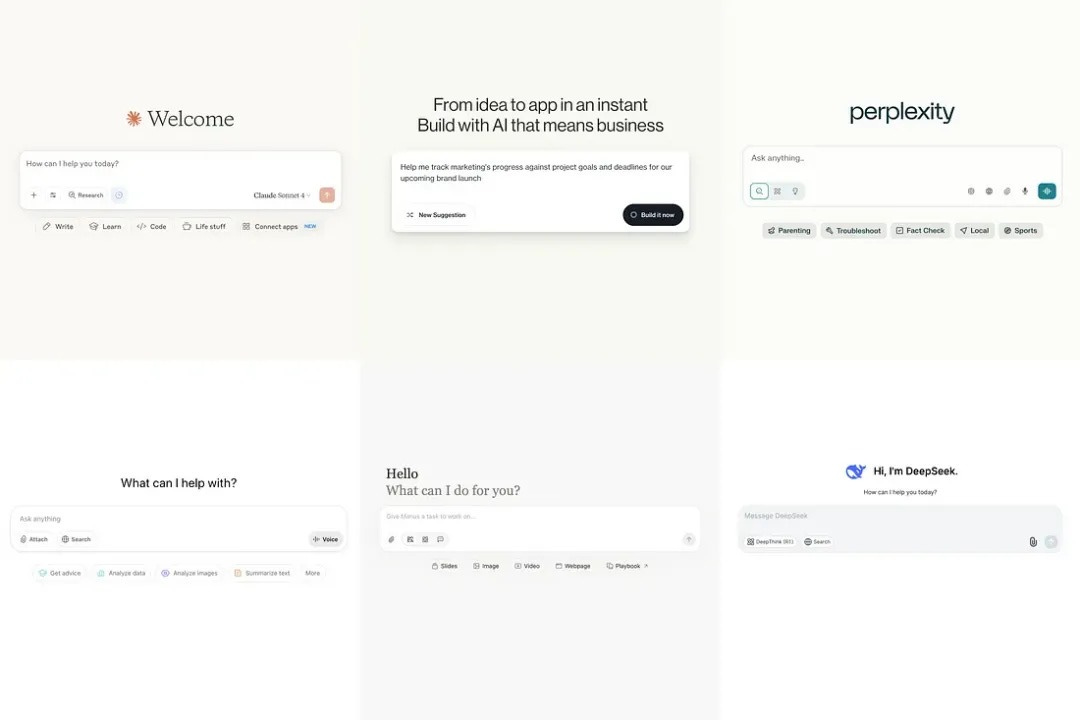
Old conversations sit on the left. An answer occupies the middle. A text box waits at the bottom. Claude, Perplexity, ChatGPT, Manus and DeepSeek have different models and increasingly different ambitions. They still tend to meet the user in the same room.
This sameness is easy to mock. It is also easy to explain.
A general-purpose model can be asked to plan a holiday, debug a Python function or write an awkward apology. Neither the designer nor the user knows what the next request will be. A blank text box is one of the few interfaces broad enough to contain all of them.
Chat also taught millions of people to tell software what they want without first learning where the product team put the button. It reverses the old arrangement: state the intention first; let the machine work out the sequence.
But an interface suited to an open-ended model is not automatically suited to work.
A useful answer may end a consumer conversation. At work, it usually begins another process.
A routine request
Consider a credit analyst on a Monday morning. A salesperson has asked to increase a customer’s credit limit from $500,000 to $800,000. The customer, a regional distributor, is preparing for a seasonal order. Sales wants an answer before the afternoon.

The request sounds like a question: can we safely extend more credit?
The work is less compact. The analyst needs the customer’s payment history, open invoices, current exposure, recent financial statements and external credit information. Two late payments may indicate deterioration, or they may be the result of disputed deliveries. The analyst also needs the current credit policy, the salesperson’s forecast and the approval threshold for an increase of this size.
Some of this lives in the ERP, some in the CRM. The latest statement is an email attachment. The disputed invoices are explained in an account note. The policy and approval matrix live elsewhere.
The analyst must assemble these facts into a decision that can survive inspection. Sales must understand it, a manager must approve it, and an auditor may later ask why the company accepted the exposure.
The answer is not the product. The credit decision is.
The well-briefed stranger
The analyst could open ChatGPT or Claude and ask for help. But first the assistant needs a briefing.
The analyst exports an aging report, collects the statements and extracts the relevant policy. The files are uploaded and the company’s rules explained. The assistant produces an assessment, but treats a cancelled invoice as overdue. The analyst corrects the context and asks again.
Eventually, the assistant recommends approving the increase with a shorter review period. The analyst then checks every number, copies the answer into a credit memo, rewrites it in the company’s format, sends it to a manager and later records the approved limit in the ERP.
The model may have saved some analytical time. It has not joined the workflow. It remains a well-briefed stranger.
This is the distinction hidden inside “assistant.” A consumer assistant waits to be briefed. A business product already has the customer record, invoices, approval hierarchy and policy. Asking the analyst to explain them again is a failure to connect the product to its own data.
The problem is not that chat cannot answer the question. It is that the answer has no reliable connection to the customer record, the approval process or the system where the decision must live.
Bringing chat into work requires more than embedding a text box. It requires redesigning the path from context to decision to action.